
By the time Dr. Jason Van Wagenen and Dr. Ken Ence sat down with Elevate Dental Partners in late 2021, they had already built something rare in dentistry: a long-established Denver practice with a 25-year patient base, a non-judgmental clinical culture, and the kind of community trust that only gets built over decades.
The question wasn’t how to fix what was wrong. The question was how to grow what was already working.
A Practice Built on a Specific Idea
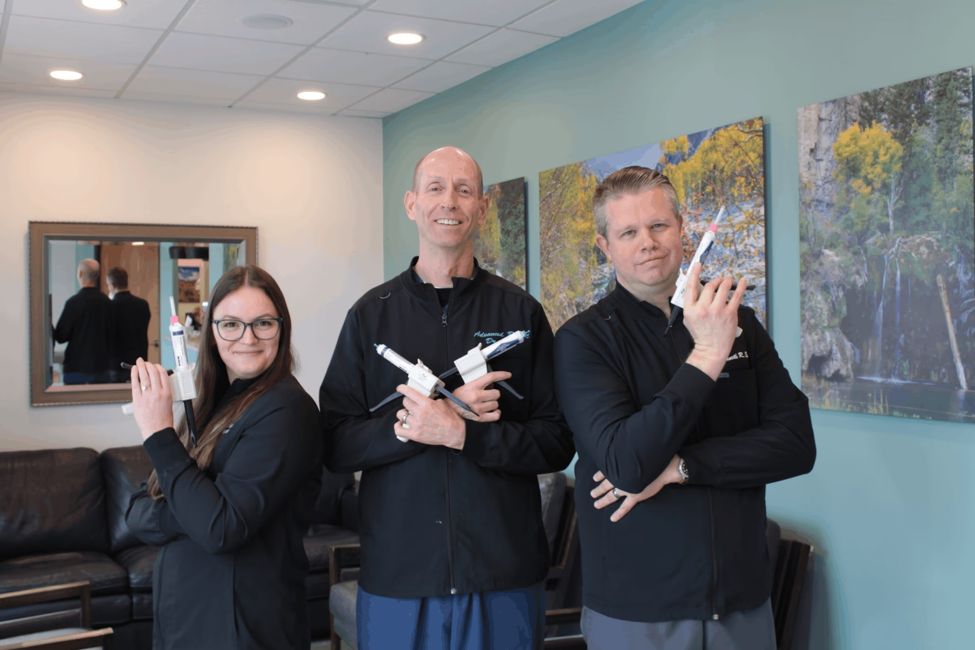
Dr. Jason has been practicing dentistry for 21 years in the Denver area. Alongside Dr. Ken Ence, he leads Advanced Dental Center with a philosophy that’s easy to say and harder to actually run a business around: treat every patient like a member of the family — and have the systems in place to actually deliver on that.
The result is the kind of patient loyalty most marketing budgets can’t buy. That’s the foundation Elevate partnered with.
Why Even a Strong Practice Hits a Wall
The clinical and cultural side of ADC was strong. The back-office side was carrying a weight that kept growing — and slowly pulling against everything else.
For Dr. Jason and Dr. Ken, the math was getting harder to ignore. The administrative and operational demands of running the business were increasingly competing with time spent on patient care and clinical leadership — the parts of the job that had made them want to be dentists in the first place.
December 2021: Choosing a Partner, Not a Buyer
Before signing with anyone, Dr. Jason and Dr. Ken evaluated several DSO and DPO models.
Elevate Dental Partners stood out from the start. The company is founder-owned, not private-equity-backed. The partnership is structured as a joint venture, which meant Dr. Jason and Dr. Ken kept ownership in their own practice. Clinical decisions stayed with the doctors. Elevate’s role was to take on the management and administrative work that was pulling them away from patient care — and to support what was already working, not redirect it.
Support, Not Control — In Practice
The first thing the Elevate team did was different from what other operators tend to do. They arrived with a question: what’s already working, and what’s getting in the way of it working better?
The answers turned into a focused operational and growth plan executed over the next four years.
Lower costs without lowering standards, and more capacity without compromising care.
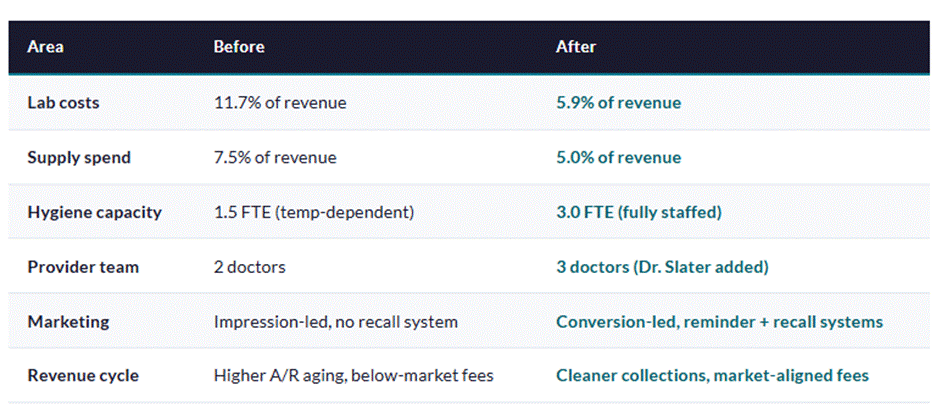
Elevate’s procurement team consolidated ADC’s supplies spend through preferred distributor relationships and renegotiated lab pricing. The results were direct and immediate:
- Supplies dropped from 7.5% of revenue to 5.0%
- Lab costs dropped from 11.7% of revenue to 5.9%
That’s nearly 8 points of margin recovered on two line items alone, without changing the quality of care or the materials patients received.
The Elevate team also re-evaluated daily workflow and scheduling rules to maximize production capability, and worked with the doctors to expand clinical capacity. Hygienist headcount grew from 1.5 to 3.0 FTE, reducing reliance on temp labor and stabilizing the schedule. An additional associate provider, Dr. Madeline Slater, was recruited and onboarded — adding chair capacity without diluting the practice’s standards.
Better targeting, fewer no-shows, more appointments.
At ADC, marketing was rebuilt around a simple idea: every dollar should bring in the right patient, not just any patient. Digital ads were optimized for conversion rather than impressions. Direct mail messaging and target areas were rebuilt around the patient profile ADC actually served. Automated appointment reminder cadences and recall/reactivation cadences were implemented, reducing no-shows and pulling lapsed patients back into the chair.
As Dr. Slater came on board and expanded clinical capacity, the marketing program expanded alongside her — designed to keep her schedule full and her ramp productive.
The result wasn’t just more new patients. It was the right new patients: stronger clinical fit, better case acceptance, and the kind of long-term relationships ADC had been building from day one.
Closing the gap between what was billed and what was collected.
ADC’s payer contracts were reviewed and renegotiated to align with market reimbursement rates. Fee schedules were updated to capture more revenue per procedure. Claim submission workflows were standardized, the clean claim rate improved, and outstanding insurance A/R received structured follow-up. The result was higher collection efficiency, reduced aging, and more predictable cash flow.
The Numbers After Four Years
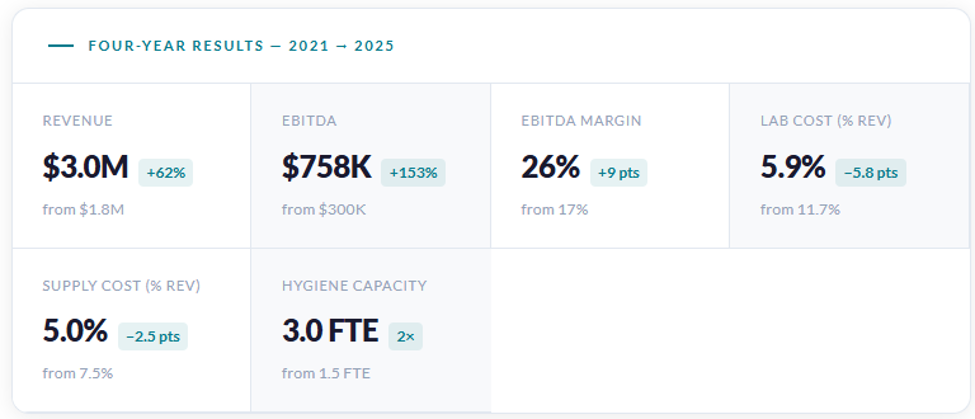
Between December 2021 and December 2025, ADC’s growth was steady, compounding, and measurable:
- Revenue: $1.8M → $3.0M — 62% cumulative growth
- EBITDA: $300K → $758K — more than doubled
- EBITDA margin: 17% → 26% — nearly 9 points of expansion
- Hygiene capacity: doubled
- Supplies and labs: combined ~8 points of revenue recovered
This kind of growth doesn’t happen by accident. It came from Elevate working with Dr. Jason, Dr. Ken, and the ADC team — together identifying what needed to change, what needed to stay the same, and what could be improved without disrupting what was already working.
What Drove the Results
The practice’s identity was treated as the asset, not the obstacle. ADC didn’t need to be reinvented. The partnership worked because Elevate understood that the culture, patient base, and clinical philosophy already in place were the most valuable things about the business — and built around them, not over them.
The administrative work went to people whose job it actually is. Supply ordering, lab negotiations, payer contracts, hygiene staffing — all of it moved off the doctors’ desks and onto teams who specialize in it. The doctors got their time back. The practice got better results on each of those fronts.
The doctors approved every change before it happened. Every operational shift started with a pain point Dr. Jason or Dr. Ken raised, and every solution was reviewed with them before implementation. Nothing was rolled out over their heads. Elevate‘s role was to support the doctors’ decisions, not to make them.
Growth doesn’t have to mean compromise.
If you’ve built a practice you’re proud of and you’re feeling the weight of running the business start to compete with the work that actually called you to dentistry, the question isn’t whether to give up control. The question is whether the right partner can support what you’ve already built and help it grow.
At the Becker's 5th Annual Future of Dentistry Roundtable, taking place September 14-15 in Chicago, dental leaders and executives will gain insights into emerging technologies, practice growth strategies and the evolving landscape of dental care delivery, with a focus on innovation, patient experience and operational excellence. Apply for complimentary registration now.
